Integrating AI Recommendations into Existing E-Commerce Architectures
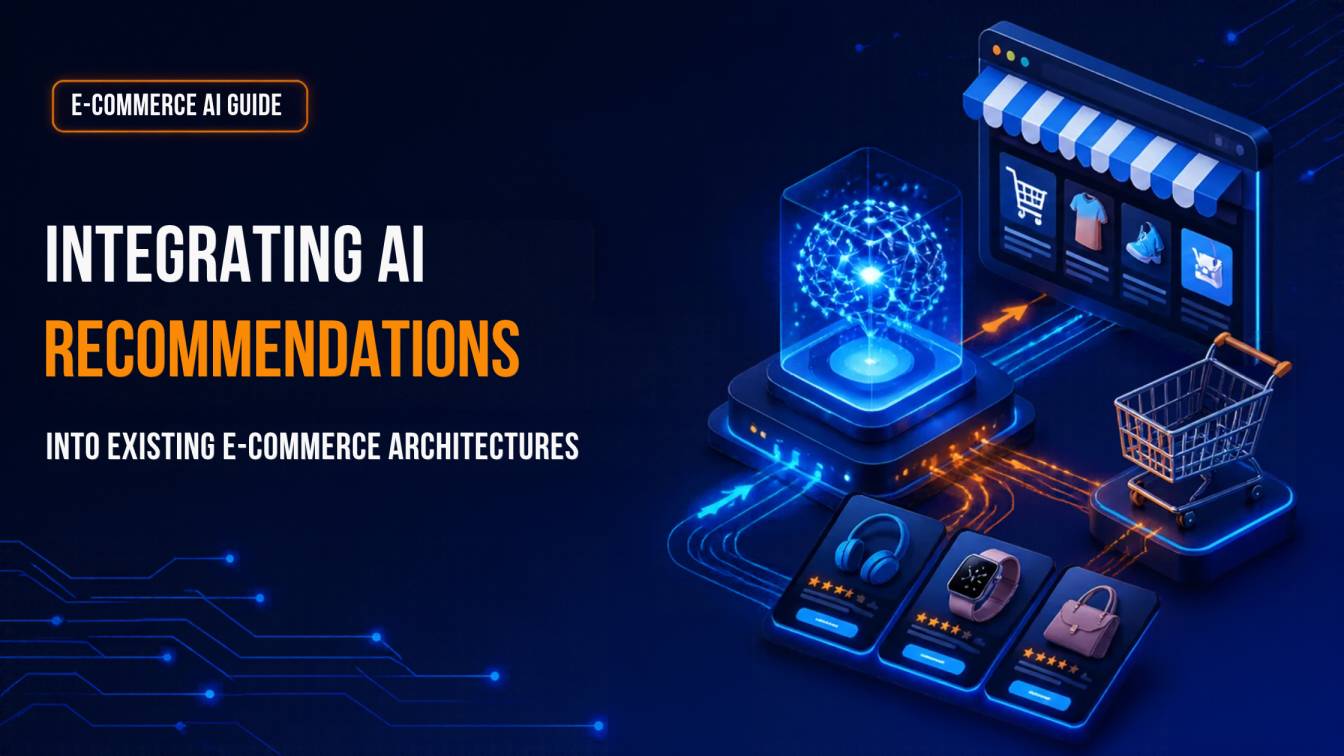
Learn how to integrate AI-driven product recommendations into your e-commerce website or mobile app. Explore architectures, algorithms, challenges, and best practices.
Integrating AI Recommendations into E-Commerce Architecture
In today’s competitive digital marketplace, generic storefronts struggle to hold buyer attention. Modern shoppers expect online stores to understand their intent, surface relevant products immediately, and simplify discovery. Integrating AI-driven recommendation systems into your e-commerce architecture turns static product catalogues into dynamic, personalised shopping experiences that improve engagement, conversion rates, and customer lifetime value.
Industry research shows that personalised product recommendations can drive a 10% to 30% increase in revenue, with major marketplaces like Amazon attributing roughly 35% of total sales to their recommendation engines. Yet for growing e-commerce businesses, the real challenge is not simply wanting AI—it is embedding it cleanly into an existing tech stack without slowing down site speed or fragmenting customer data.
Here is a practical guide to how AI recommendation engines work, the architectural considerations involved, and how businesses can implement them effectively.
What Are AI Recommendations in E-Commerce?
AI recommendation systems use machine learning models to analyse customer behaviour, contextual signals, and product attributes to predict what a shopper is most likely to view or purchase next. Rather than relying on manual merchandising rules, these systems adapt automatically as user behaviour evolves.
At the core of most e-commerce recommendation engines are three primary filtering approaches:
- Collaborative Filtering: Identifies patterns across users with similar browsing and purchase histories to recommend items bought by comparable shoppers (e.g., "Customers who bought this also bought").
- Content-Based Filtering: Analyses product metadata—such as category, brand, price tier, material, or style—to recommend items similar to those a user has already viewed or liked.
- Hybrid Models: Combines collaborative and content-based filtering alongside real-time session context to deliver accurate suggestions even for first-time visitors or newly listed inventory.
Key Business Benefits of AI-Powered Product Recommendations
When integrated directly into web storefronts and mobile shopping apps, AI recommendation engines deliver measurable operational and revenue gains:
- Higher Conversion Rates and Average Order Value (AOV): Surfacing complementary items on product pages, in-cart drawers, and checkout flows encourages natural cross-selling and upselling without friction.
- Stronger Customer Retention: According to Statista, 75% of consumers prefer brands that deliver personalised shopping experiences. Tailored product discovery builds familiarity and drives repeat purchases.
- Smarter Inventory and Demand Forecasting: Beyond front-end merchandising, predictive analytics models help retailers anticipate seasonal demand, highlight slow-moving stock to relevant segments, and reduce overstocking.
- Consistent Omnichannel Experiences: Modern AI engines unify user preferences across web browsers, mobile apps, and conversational AI chatbots so shoppers receive coherent suggestions wherever they interact with your brand.
Core Architectural Considerations Before You Integrate
Successfully embedding AI into an existing e-commerce platform requires aligning your data layer, application logic, and user interface. Before selecting or building a recommendation engine, evaluate four technical pillars:
1. Data Integration and Quality
AI models are only as reliable as the data feeding them. Your recommendation system needs clean, structured access to clickstream events, search queries, cart additions, purchase history, and product catalogue metadata. Auditing and standardising data pipelines early prevents inaccurate or repetitive suggestions.
2. Real-Time Processing vs. Batch Updates
Static batch recommendations updated once a day miss in-session intent. High-performing architectures combine historical batch training (for long-term customer preferences) with real-time event streaming so that if a shopper browses running shoes, the storefront immediately surfaces athletic socks, insoles, or fitness trackers within the same session.
3. API Compatibility and Scalability
Whether your store runs on Shopify, WooCommerce, Magento, or a custom web and mobile stack, your AI layer should connect cleanly via modular APIs. Cloud-native deployment ensures that recommendation latency stays low even during peak traffic events like festive sales or flash drops.
4. Privacy, Security, and Compliance
Using behavioural data requires strict adherence to data protection standards such as GDPR and India’s Digital Personal Data Protection (DPDP) Act. Anonymising user identifiers, securing API endpoints, and maintaining transparent consent controls protect both customer trust and regulatory compliance.
5 Steps to Implement AI Recommendations in Your E-Commerce Stack
Step 1: Audit Your Current Tech Stack and Customer Journey
Map out your existing storefront, CRM, ERP, and analytics setup. Identify high-impact placement zones where recommendations add genuine value—such as the homepage, product detail pages (PDPs), empty search states, shopping cart drawers, and post-purchase emails.
Step 2: Choose Between Off-the-Shelf Tools and Custom AI Development
For standard storefronts with straightforward catalogues, plug-and-play tools can offer a quick starting point. However, businesses with complex product hierarchies, multi-vendor marketplaces, custom mobile apps, or proprietary customer data often achieve far better ROI with custom machine learning models or Retrieval-Augmented Generation (RAG) workflows tailored to their exact business logic.
Step 3: Connect Data Sources and Build API Pipelines
Integrate your product catalogue, inventory status, and user event tracking into a unified data pipeline. Ensure out-of-stock items are automatically filtered out in real time so shoppers are never recommended unavailable products.
Step 4: Train, Pilot, and Validate the Model
Start with a focused pilot—such as launching AI recommendations on your top-performing product category or mobile app home screen. Validate recommendation relevance against historical purchase data before rolling out across the entire platform.
Step 5: Monitor KPIs and Run Continuous A/B Tests
Track key performance metrics including click-through rate (CTR) on recommended widgets, conversion rate lift, average order value, and revenue per visitor. Use ongoing A/B testing to refine model weights, UI placement, and recommendation triggers.
Common Integration Challenges and Practical Solutions
|
Challenge |
Impact on E-Commerce |
Practical Solution |
|
Cold-Start Problem |
New visitors or newly added products lack historical interaction data. |
Use hybrid models combining content attributes, trending items, and session-level signals until enough user data is collected. |
|
Legacy System Silos |
Customer data sits trapped across disconnected CRMs, POS systems, and storefronts. |
Build middleware APIs and centralised data lakes to unify customer profiles across touchpoints. |
|
High Page Latency |
Slow recommendation APIs delay page rendering and hurt Core Web Vitals. |
Use asynchronous front-end loading, edge caching, and lightweight inference endpoints. |
|
Algorithmic Bias / Echo Chambers |
Showing overly narrow items limits product discovery. |
Introduce diversity rules and exploration thresholds so shoppers discover new categories alongside familiar favourites. |
Emerging Trends Shaping E-Commerce Personalisation
As AI capabilities mature, product discovery is moving well beyond static "You may also like" carousels:
- Conversational AI Shopping Assistants: Intelligent chatbots powered by Large Language Models (LLMs) and RAG can ask clarifying questions, understand budget or style constraints, and recommend exact products directly inside a chat interface.
- Visual Search and Computer Vision: Shoppers can upload an image or screenshot of an outfit, furniture piece, or gadget and instantly find visually matching items in your catalogue.
- Predictive Lifecycle Triggers: AI models increasingly predict when a customer is due to replenish consumables or likely to churn, triggering timely, personalised offers across web, app, and email channels.
Ready to Build Smarter E-Commerce Experiences with AppyMinds?
Integrating AI recommendations into your e-commerce architecture does not have to mean rebuilding your entire platform from scratch. With the right data pipelines, API integrations, and machine learning models, you can transform how customers discover and buy from your brand.
At AppyMinds, we help businesses design, build, and integrate custom AI solutions—from machine learning recommendation engines and AI data analytics to conversational AI chatbots, custom web platforms, and AI-powered mobile apps. Whether you are upgrading an existing storefront or building a scalable digital commerce product from the ground up, our engineering team turns AI strategy into measurable business results.
Discuss Your Project with AppyMinds to explore how custom AI integration can elevate your customer experience and accelerate sales.
Frequently Asked Questions (FAQs)
1. Can AI recommendation engines be integrated into an existing e-commerce website?
Yes. Modern AI recommendation systems connect to existing storefronts via REST or GraphQL APIs, allowing you to add personalised product carousels, smart search, and conversational assistants without replacing your core platform.
2. How much data is needed to start using AI product recommendations?
While larger datasets improve deep learning accuracy, businesses can start effectively using content-based filtering and hybrid models with existing product catalogue attributes and a few weeks of user browsing and order logs.
3. How do AI chatbots enhance e-commerce product recommendations?
AI chatbots use Natural Language Processing (NLP) and Retrieval-Augmented Generation (RAG) to understand customer intent in real time, guiding shoppers to the right products through natural conversation while answering sizing, shipping, or compatibility questions instantly.
4. Should I use a plug-and-play recommendation plugin or build a custom AI recommendation engine?
Off-the-shelf plugins work well for small stores with simple product catalogues and standard templates. However, if you manage large or complex inventories, operate across both web and mobile apps, or need recommendations tailored to custom business rules and CRM data, a custom AI solution provides higher accuracy, faster API performance, and full ownership without recurring per-order plugin fees.
5. How do AI recommendation systems handle new products or first-time visitors with no browsing history?
This is known as the cold-start problem, and modern AI architectures solve it using hybrid recommendation models. For first-time visitors, the system analyses real-time session signals—such as referral source, location, device, and current clicks—alongside trending items, while newly listed products are matched to shoppers using product attributes, tags, and computer vision similarity.
About the author

Santosh Shet
Santosh Shet is the Founder of Appyminds and a technology entrepreneur with over 20 years of experience in software development, web applications, mobile apps, AI solutions, and business automation. He helps businesses transform ideas into scalable digital products through modern web development, mobile applications, intelligent automation, and AI-powered solutions. Santosh regularly writes about artificial intelligence, software development, digital transformation, SaaS products, and emerging technology trends.